
From Pronk to Peanut Butter
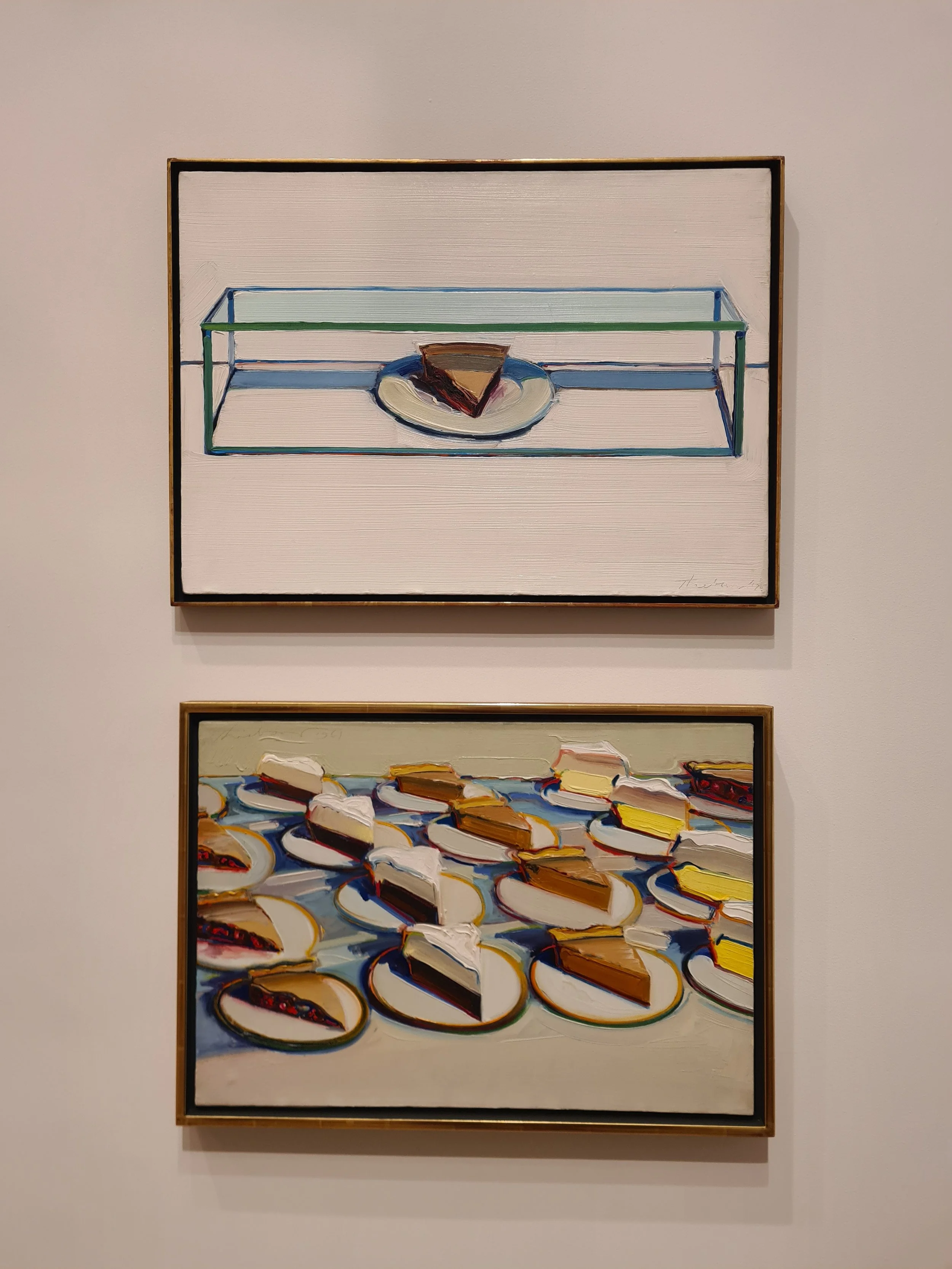
American Still Life - Wayne Thiebaud
How still life reflects - and defines - the food of an era, featuring artist Ben McDonald and author Katie Goh.
Find Ben online:
Instagram: @ben___mc
Ko-Fi store: ko-fi.com/benmc/shop
Find Katie online:
Instagram: @katie_goh_
Website: katiegoh.co.uk
Books referenced:
National Gallery Pocket Guide to Still Life - Erika Langmuir
Looking at the Overlooked - Norman Bryson
This Dark Country - Rebecca Birrell
The Dutch Table: Gastronomy and the Golden Age of the Netherlands - Gillian Riley
Artworks mentioned:

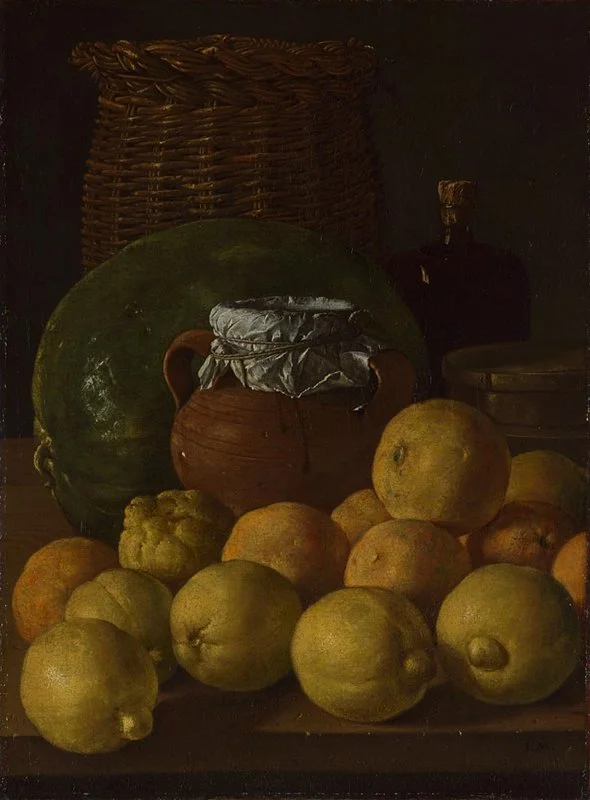
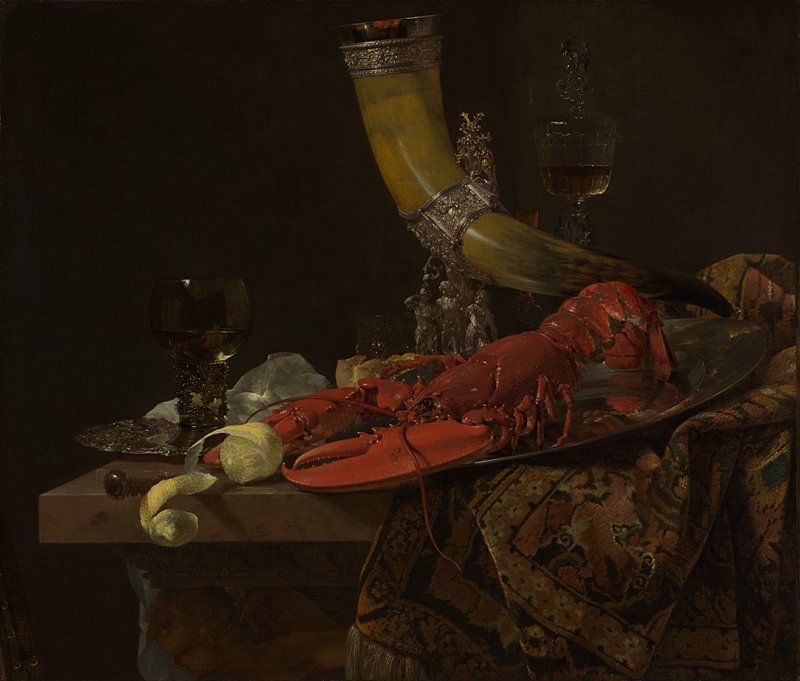
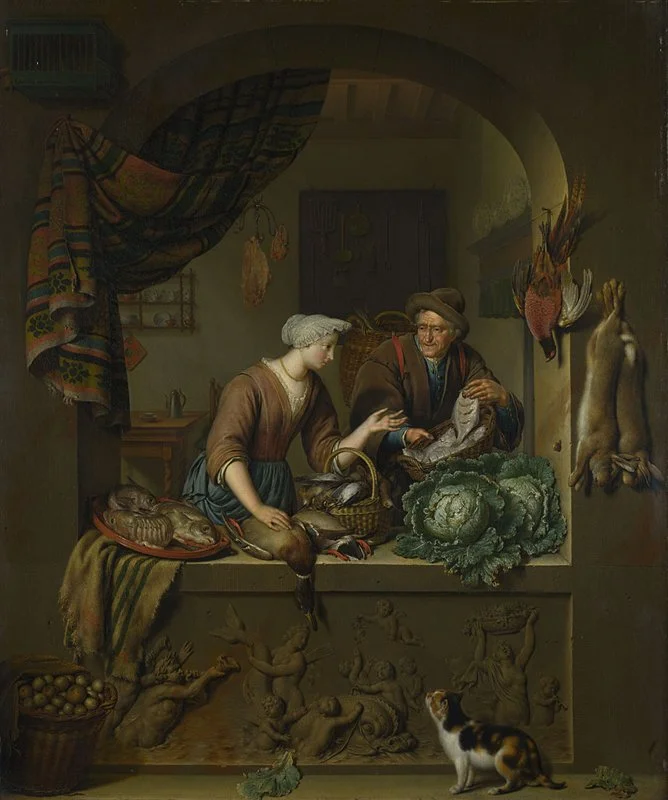

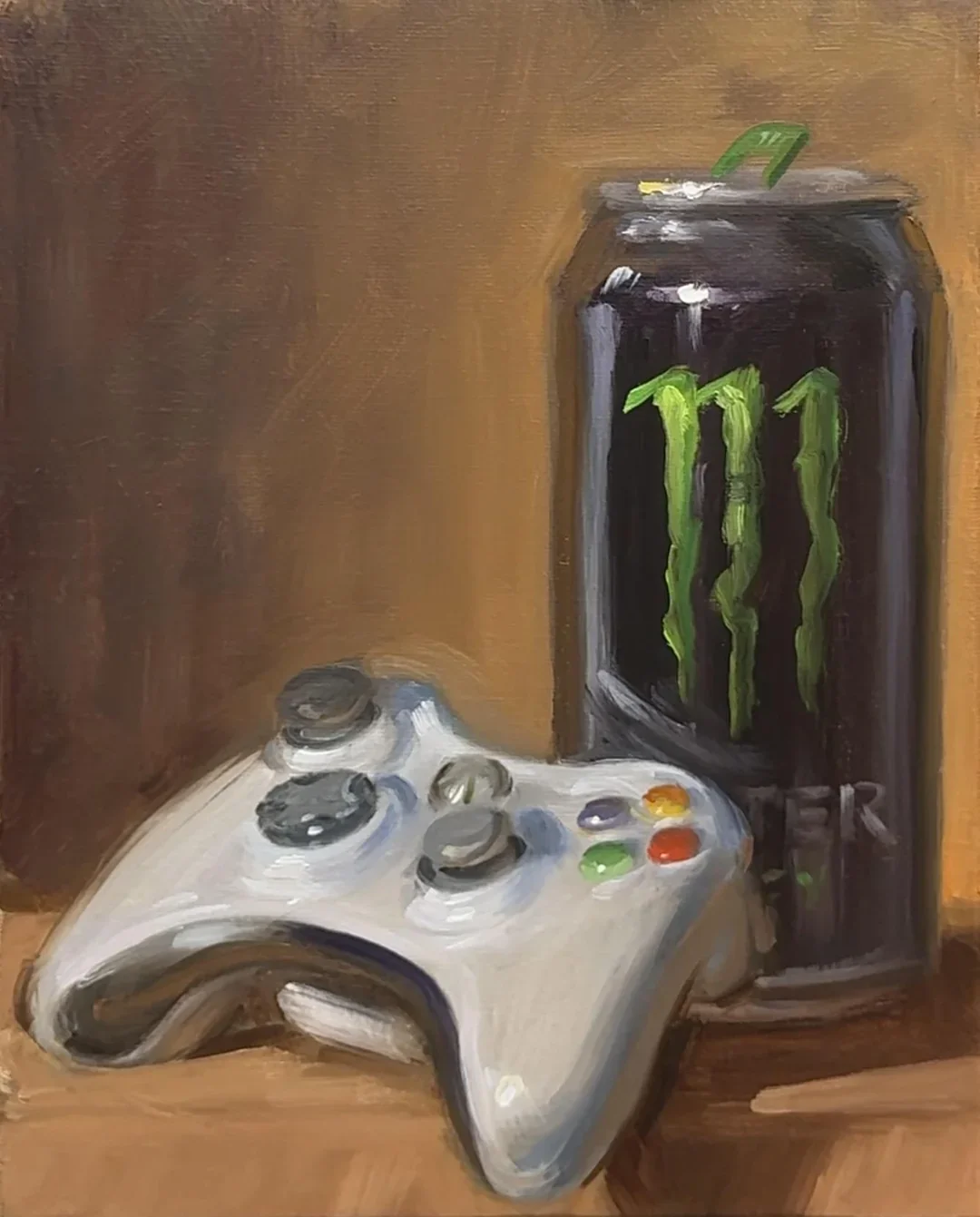
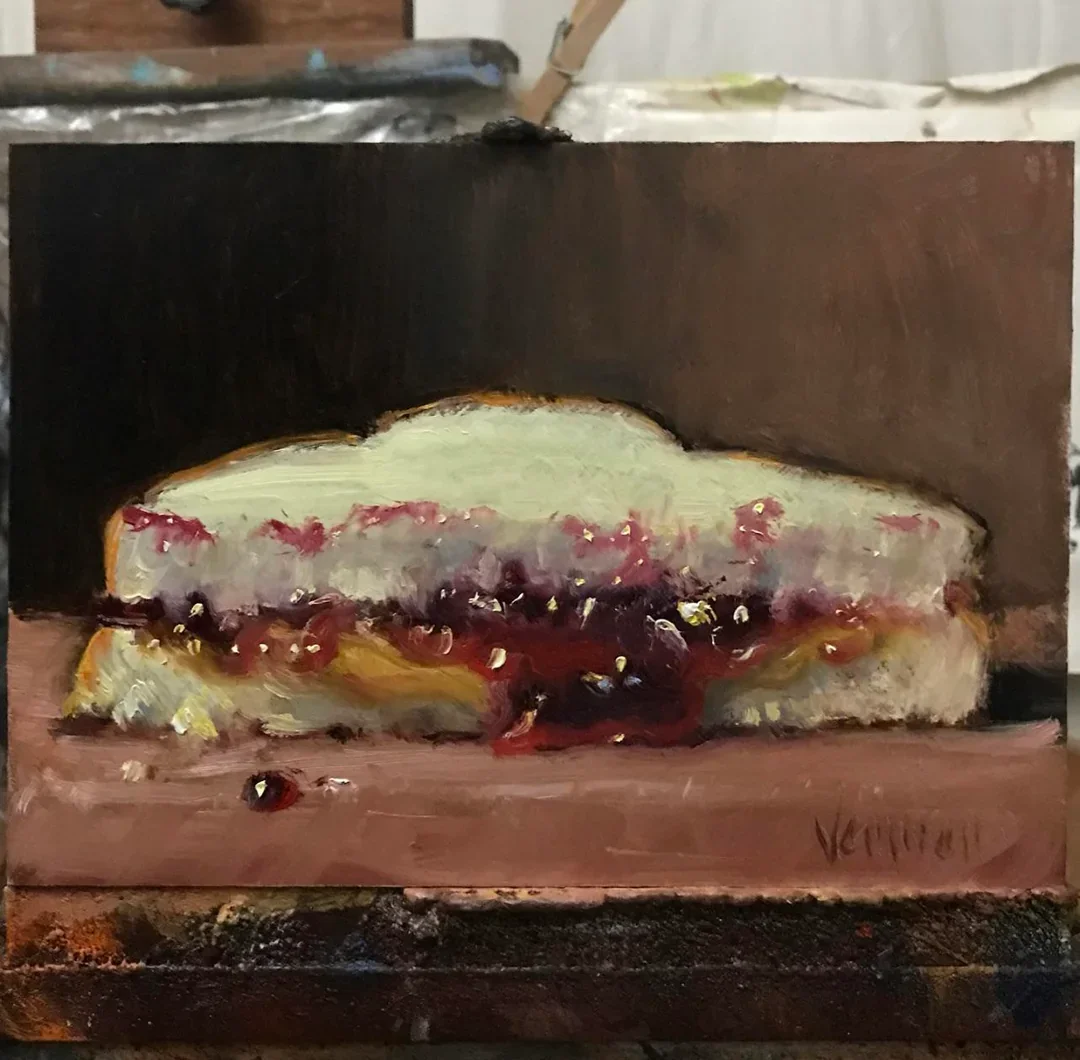
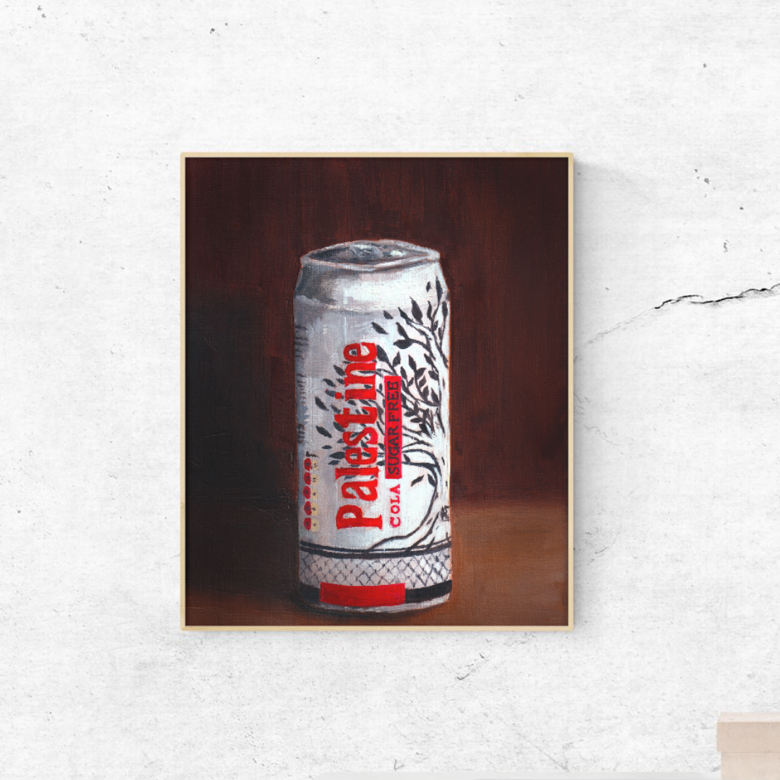
Full transcript available after the embed
Lecker is a podcast about how food shapes our lives. Recorded mostly in kitchens, each episode explores personal stories to examine our relationships with food – and each other.
Looking for something to read? Find all of the Lecker Book Club reads on my Bookshop.org list. [aff link]
Support Lecker:
Patreon: patreon.com/leckerpodcast
Substack: leckerpodcast.substack.com
Apple Podcasts: podcasts.apple.com/gb/podcast/lecker/id1158028729
Merch: leckerpodcast.com/merch
Listen everywhere: leckerpodcast.com
Instagram: @leckerpodcast
Full transcript available at leckerpodcast.com
Music by Blue Dot Sessions
[00:00:05] Ben: So we are in my studio. I'm saying that in quotation marks 'cause it's a desk in my garage. But we're very, I'm very lucky to have like a space in my home where I'm able to focus on my artwork. And a lot of artists don't have that. Right.
[00:00:21] I have sort of bits of materials everywhere. It's a bit of a bomb site and I usually, like when I sit down to make work, I'll usually spend a bit of time tidying it... cleaning brushes. 'cause I'm really bad at cleaning brushes. I've got two here that I was. I'd left to soak, which I've actually been ruined by my little makeshift paint cleaner.
[00:00:43] Lucy: This is Lecker. I'm Lucy. Dearlove,
[00:00:51] I'm with my friend Ben McDonald in his studio, which is in the garage of his house. If you're a longtime Lecker listener, then you'll definitely have seen Ben's work. He produced beautiful pencil drawings to accompany many of the early episodes.
[00:01:06] Ben: This is how I usually work. I have like a board that props up whatever I'm working on. It's maybe worth saying I've only recently started getting into, into painting. I have mainly worked drawing for the majority of time I've made artwork, but was really interested and wanted to like, move into painting more recently.
[00:01:30] Lucy: Why do you think you wanted to move into painting?
[00:01:33] Ben: I don't really know why. I always, I do think that like, even though I, like, I really love drawing, I don't think drawing is taken as seriously as most other art forms.
[00:01:44] I'm a art school dropout, so I don't have any like, formal training, so it's really nice to, as well as like challenging... 'cause I'll spend, I could, I, there's been times I spend like. I was painting something and then take a step back and I'm like, I fucking hate it.
[00:02:01] Lucy: And with drawing did it not feel like as high stakes as that?
[00:02:05] Ben: I think at first. I mean, the materials are more expensive. Yeah. So there's that.
[00:02:09] Lucy: And we're talking about like, you're working in acrylic, right? So you've been doing oil.
[00:02:13] Ben: I mainly work in oils.
[00:02:14] I don't really work in. Yeah. I've not, um, I think they. I feel like it's a way for oil painters to like, dismiss the quality of acrylic painting, but there's this narrative that like acrylic paintings for babies or like beginners, and oils are for, for the, for the real painters, which is stupid.
[00:02:35] But I think the thing that I've found is really nice. And it's interesting that you mentioned about higher stakes. I feel like with. With, I've found anyway, with oil painting, like there's so much more room for like, flexibility and it's easier to like correct things that you think might be a mistake.
[00:02:54] And on the other hand it's like easier to make a mistake and for that to be like a happy accident.
[00:02:59] Lucy: So tell me a bit about your work. Like in general, kind of whatever medium you are working in. What do you see as the kind of like central theme of your work?
[00:03:09] Ben: Yeah, so I did the bottle lily art market in Hastings recently, and you have to send like a short spiel and I've kind of nailed it down to like: my name is Ben McDonald. I am an artist predominantly working with drawing and painting, working with the themes of queer joy and queer identity. Meme culture, uh, meme and internet culture, ranging from like, reality tv. My big hit is the British, the painting of the British lads hit each other with chair video. So I've like, yeah, mainly worked in those themes.
[00:03:45] Lucy: Ben's not kidding. He sold thousands of prints of his drawing of a still from the British lads hit each other with chair video when he did the art market in Hastings that he mentioned. I sat on his stool with him for a bit and watched as people's faces either lit up with recognition of the scene or screwed up in the amusement as Ben tried to explain the reference to them.
[00:04:08] Ben: I've only recently started moving into, or like making more like still life works because I think it's like a really good way to get better.
[00:04:18] Lucy: This is really what I'm here to talk to Ben about today, the evolution of his own practice to incorporate more works painted from life, but also about his expansive view on what still life can encompass and represent.
[00:04:37] Ben: I think it's really interesting how artists are sort of like, re-tracking the narrative around what still paintings historically have been used for. And what, like a still life painting can be.
[00:04:50] I recently finished a painting from one of the early Tomb Raider games where you could lock the butler in the fridge, in the house. And when you first asked me about, like, speaking about, still lifes and when we were like chatting about what things that I think would be interesting to talk about is like the, historically I think the main definition of a still life is objects or items that are arranged by the artist and painted from life.
[00:05:15] And I was thinking about that when I was doing that Tomb Raider painting because that is something that like, it's in a virtual world and I've had to.... sort of, even though I've painted it from an image, those are.... it's a virtual thing that I have like constructed in front of me, you know?
[00:05:31] Lucy: I found still life as a genre of art relating to food. Interesting for quite a long time, probably, especially since I made a Lecker episode in 2022 called Oranges and Lemons. I didn't end up actually looking at citrus in art in the episode itself, but as part of the research, I went to the National Gallery and I walked around looking for painted citrus fruit.
[00:05:56] The earliest lemon I could find was from a portrait of a boy aged eight by the Dutch painter, Ferdinand Bol from 1652 with a half peeled lemon positioned next to the titular boy, and I also enjoyed Luis Melendez still life with lemons and oranges, the fruit in question piled up luxuriously and Willem Kalf's
[00:06:18] Still life with drinking horn, where another half peeled lemon rest on a platter next to a scarlet lobster.
[00:06:26] In a pocket guide book to the National Gallery's Still Life Collections, Erika Langmuir wonders why the gigantic luscious savoy cabbages piled on the table in Willem van Mieris's painting: a woman and a fish pedler in a kitchen are so exhilarating.
[00:06:43] That's what she says about them. I draw my attention away from the woman and the fish pedler plus their surrounding wares: fish , hares, birds to examine the cabbages, they glow as if gently spot lit. Their generous outer leaves blossoming apart to reveal a tender heart.
[00:07:01] Sometimes the food in still life painting is beautiful, ornate and desirable in its own right, but very often it is commonplace household items, Langmuir writes. It is their re presentation in paint that makes them seem remarkable and a source of special enjoyment.
[00:07:21] Katie: When I was studying art in school, they made us do so many still lives. Like we, I drew so many oranges and there's a bit early in the book where I do my own like still life and draws of oranges and kind of have my like existential crisis about like representing the world through art, which is something that I feel very much thought as like, uh person who writes memoir.
[00:07:45] Lucy: In Katie Goh's memoir Foreign Fruit, a Personal History of the Orange, she writes about another painting by Willem Kalf from 1669: still life with a Chinese porcelain jar. In the book, she doesn't name the painting explicitly and I have to cross reference the images I find online of his still lives with her description of the composition, because Kalf painted a series of extremely similar works tables with platters of half peeled oranges, lemons, ornate glassware, Ming porcelain jars, tapestries.
[00:08:23] Katie: I really was curious about like the Dutch golden age and this time when the Dutch went to Indonesia and they discovered in quotes, spices. And that became how they got rich basically. And then them expanding their horizons, their empire, discovering spice, discovering citrus, discovering these sort of like... foreign things and then becoming quite obsessed about it and bringing it back to the Netherlands or Holland and artists painting it into still lives.
[00:08:52] I was really curious about this idea of like, well, the things that are in a still life painting, none of them are really European, so like the porcelain is from China, the fruit is from maybe the Mediterranean or further afield. The glassware from Venice, the rugs are from Turkey. All of these things. But then they're brought together in like this painting that's gonna hang in a Dutch living room.
[00:09:16] And I think I was curious about why still life was so popular in the Netherlands at that time. And a lot of people think it's to do with sort of glorifying empire, showing off that they, like this sort of middle class, this new middle class were able to buy still lives and buy art. And it became a way of sort of like almost collecting these sort of foreign goods, but in a way that they would stay eternally so through the still life.
[00:09:43] Lucy: The art critic Norman Bryson wrote extensively about Willem Kalf in his book, Looking at the Overlooked: Four Essays on Still Life Painting. In chapter three, Abundance, he argues that Dutch still life painting of this era was a dialogue between a newly wealthy society and its material possessions, which involved a reflection of wealth back to the society that produced it.
[00:10:11] Central to this idea, he claims, is overproduction. The Netherlands was the first European society to experience this problem of oversupply and overproduction, something that we are now well accustomed to in industrialized countries. Unlike other countries, the Netherlands lacked mechanisms for absorption of surplus wealth, such as the Court of Versailles, for example. -And so its art created a reflection of how this phenomenon of plenty could be interpreted.
[00:10:47] There's an entire genre of still life: pronk, a Dutch word, meaning literally show off, which centers extremely and ostentatiously luxurious items in a conspicuous presentation of wealth and consumption. Kalf, Bryson argues. perfected pronk. Not only did he paint edible objects of this genre, but also included artifacts like pocket watches, ornate glasses, and Chinese porcelain jars, as Katie has explained.
[00:11:17] Katie: But I also wanted to question the idea of like, well, what was painted into the still life? It's very artificial in a lot of ways. The orange is very artificial. The fact that everything in the still life is like like almost caught between being ripe and being decaying is really interesting as well. There's a lot of like precariousness in still life. Like normally there'll be like an orange or a lemons peel, sort of like spiraling and just about to topple, or things are kind of in weird positions where you're like, well actually the physics of that doesn't work.
[00:11:49] If that piece of glass was on top of that porcelain, on top of that tin plate, like it would all kind of crash and crumble the minute that the painting is back in motion. So I was really interested in like, using the art and the still life to think about empire, but then also think about like representations of empire or representations of just life around us.
[00:12:11] And again, these questions were like authenticity, artificiality.
[00:12:16] When does something become native after it's been foreign for so long, like how long does that take? What is that kind of process like? So yeah, still life became a really handy way of like writing about all that kind of stuff.
[00:12:28] Lucy: Norman Bryson also rages against these compositions of Kalf's, claiming his depiction of crafted objects "puts under threat their substantiality:, and though he doesn't say it in as many words. I suppose he also means their authenticity too, in terms of whether they are authentically painted from life.
[00:12:51] Are they real? He demands. Did they actually exist in Kalf's studio? in another of Kalf's paintings? Still life with an Nautilus Cup, another Ming jar and half peeled lemon. These guys love a half peeled lemon! Rest next to an ornate Turkish rug and a Venetian glass goblet laced on the outside with filigree. Objects from distant places, which the Dutch elite developed taste for in the process of their colonial project.
[00:13:20] Bryson calls this a male colonization of the household, quote, absorbing it into the larger and abstract space of the commercial empire. I am fascinated by his arguments about still life and masculinity in this book that I've mentioned already, Looking at the Overlooked. It's impossible to ignore that almost every still life painting of note pre 20th Century is attributed to a man and equally undeniable that the subject matter of this genre, by and large belongs to the domestic sphere.
[00:13:57] Bryson calls it the life of the table, of the household interior, of the basic creaturely acts of eating and drinking. But this environment is disrupted in its historic depictions on canvas. It is, as he puts it, totally refashioned in male terms. This is particularly evident in pronk still lives, some of which are littered with masculine paraphernalia like swords, watches, documents, pipes, tobacco drinks.
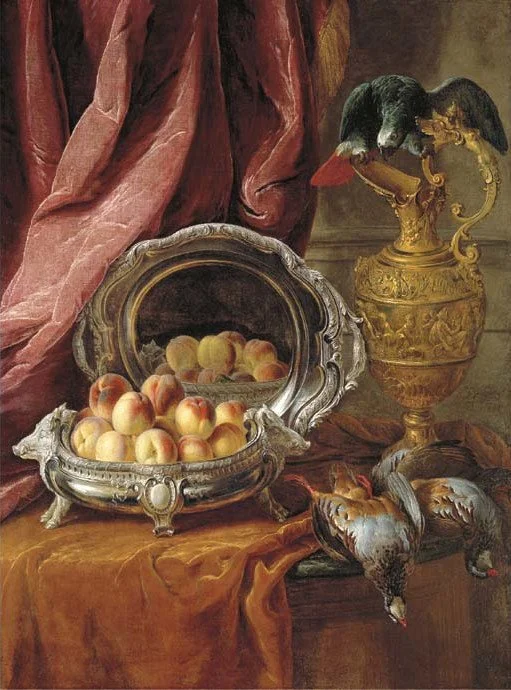
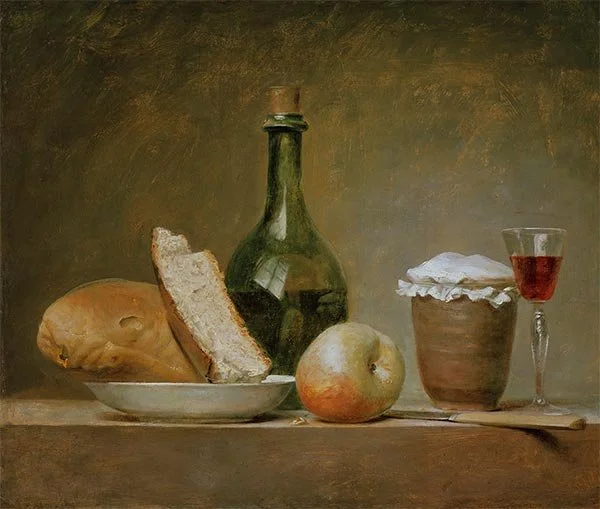
[00:14:32] Bryson makes a comparison between a painting by Francois Desportes depicting ripe peaches in a silver vessel next to two dead partridges, and Still Life with a Round Bottle by Anne Vallayer-Coster. In the former, no coherent domestic space can be inferred from the display. The peaches exist only to demonstrate the reflectiveness of the silver platter resting behind the bowl or perhaps also the artist's talent in depicting them. And the peach's inclusion next to this raw game makes no sense at all at the level of taste buds, he says.
[00:15:10] In contrast, still life with a round bottle, with its spread of a bowl of bread, an apple, a fabric, litted jar, and a small stemmed glass of red wine alongside the bottle shows domestic life as it is.
[00:15:24] The still life of luxury appropriates the table and recasts it in terms of male wealth and social power concludes Bryson.
[00:15:34] Katie: Citrus really, it's a very chic fruit, I think. And like it looks, it looks really good like there's a reason why. Or like there's, it's patterned a lot. Like there's like patterns of citrus and lots of things or, yeah, it's like on Instagram a lot like blood oranges or like unusual citrus.
[00:15:50] Lucy: Back to Katie Goh. And I've just introduced her to my theory that to exist in contemporary digital communities such as Instagram or other forms of social media, is to be confronted constantly with forms of still life. I've particularly noticed this with citrus fruit such as blood oranges.
[00:16:13] There was a season a few years ago, maybe 2018, 2019 when I really noticed it. There was just everywhere I looked, there were pictures of ripe blood oranges, and I think it's art.
[00:16:31] Katie: It looks really beautiful. And then also that sort of like the symbolic quality of it. And I think also with something like blood oranges, again, it's like a status sort of thing where it's like... I have access that only grows at certain times of year, it's only popular at certain times of year and like showing that a little bit.
[00:16:50] Fruit, I think it's just so interesting because we have a very different relationship to fruit than like a vegetable. No one's taking like cuttings of carrots or like posting them on Instagram. But there is something about fruit and I think it is like connection to religion a lot of the time.
[00:17:05] But like fruit is so symbolically important in like religious teachings and is so potent with
[00:17:13] Lucy: Yeah.
[00:17:14] Katie: metaphor and symbolism. The taste of it is so appealing to our senses. 'cause you know, fruit designed itself to be appealing because obviously it contains seeds and the seeds want to be spread throughout the world, so it wants to taste delicious so that animals and people eat them, and then they just like, you know, throw the seeds everywhere.
[00:17:31] Fruit is like the ovary off the plant as well. And I think that there's something quite sensual about fruit and like the juiciness and like, like visceral feels to eat fruit that I think. It really appeals to our senses. And like when you see a piece of like, blood orange on Instagram, you can like almost taste it and you're like, oh, like I wanna take a bite of that.
[00:17:54] Both those things, the sensuality of it and also the still quite like luxurious aspect of like specific types of fruit, but they're not really posting about like the naval oranges that you buy in like a big bundle as much.
[00:18:08] And again, it's interesting because like what we think is like mundane fruit also were once foreign to here and we're once also like exotic here. Like apples are not native to Britain and yet we think of them as pretty native to Britain. But they came from central Europe and at one time they were exotic and luxurious and people would've posted them on Instagram if they'd had Instagram back in like back in the day. Yeah. It's just interesting how like tastes sort of changed, but also stayed. They're very much the same, across different moments of history.
[00:18:37] Lucy: In 1918, so the story goes, the economist and art collector, Maynard Keynes jumped out of a car on a dark country road in Sussex and, facing a long trek up a dirt track to his friend's house, ditched his heavy suitcase in a bush to fetch later and set off without it.
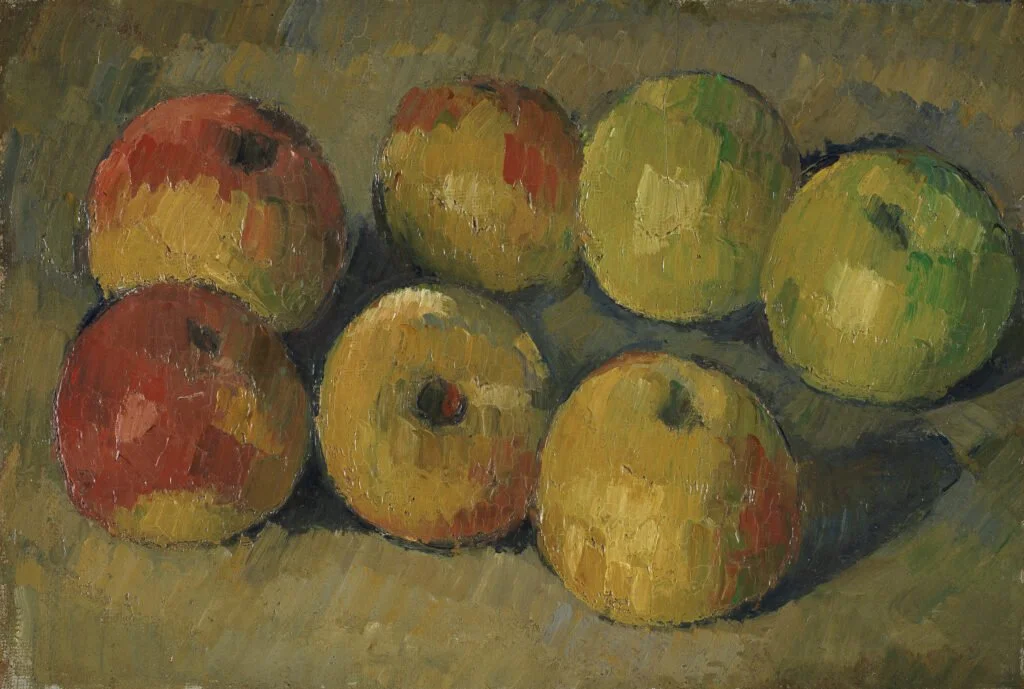
[00:18:57] Inside the suitcase, presumably alongside the usual things one packs for an early 20th century weekend trip: shirts, underwear, books was Cezanne's original painting. Still Life with Apples purchased at auction in France for 500 pounds. And the story of that auction is a fascinating one in itself, but not one for here.
[00:19:22] Once inside the house, Maynard Keynes told his friends, the artists Duncan Grant and Vanessa Bell, if you'd like to go down to the road, there's a Cezanne just behind the gate. Cezanne's apples dominate the canvas. The painting is merely apples nothing but, but the canvas writhes with beauty, power, potential. Seeing the painting at a later date. Bell's sister, Virginia Woolf, wrote in her diary: what can six apples not be?
[00:19:58] Rebecca Birrell wrote in her book, This Dark Country: Women Artists, Still Life and Intimacy in the early 20th Century, " for Woolf still, life is not simply something to be looked at, but is also a way of looking and being that occasions an intensification of its subject and surroundings."
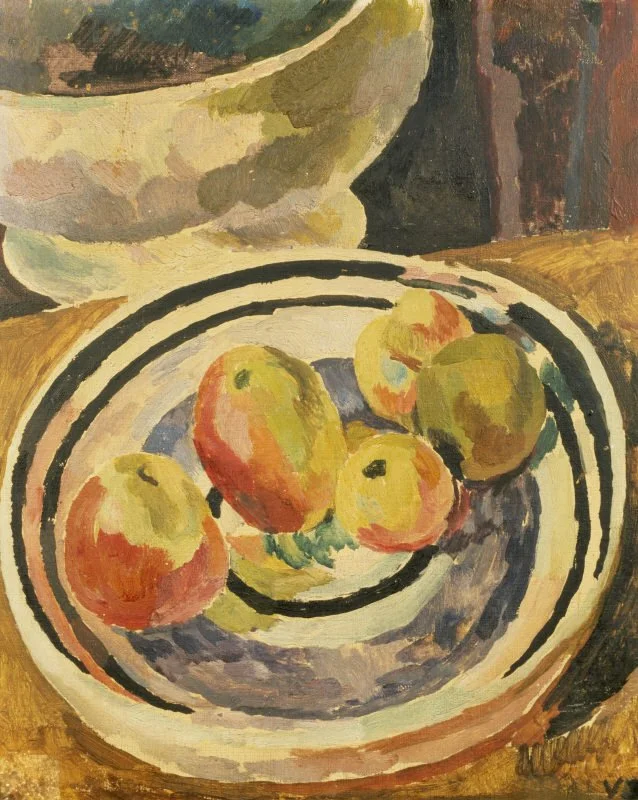
[00:20:19] Birrell connects this episode, the Cezanne from the Hedge, being unveiled by candlelight, Charleston Farmhouse to Vanessa Bell's own painting, Still Life with Apples where the fruit are placed explicitly in the setting of her own home. She writes: while Cezanne's fruit float against a backdrop of opaque color, Vanessa's are arranged on a patterned china plate, sweet and uneven, and shining, fragments of the surrounding interior, pushing in from all sides of the frame.
[00:20:52] Alongside Looking at the Overlooked by Norman Bryson, This Dark Country really helped me understand this and domesticity related tension in still life painting. The book's title itself is taken from a Virginia Woolf essay, Women and Fiction, and the passage begins: often nothing tangible, remains of a woman's day.
[00:21:14] I was struck by the irony of the longevity of the meals hanging in galleries all around the world, predominantly created by men, still lives, when compared with the millions, billions of meals cooked by women throughout history and largely forgotten.
[00:21:32] As Birrell puts it: part of the magic of still life is an awareness of matter's ephemerality how time has been halted or reversed on canvas, as well as a kind of mediumship in which obsolete objects are brought back to life, made to speak through the scored through line
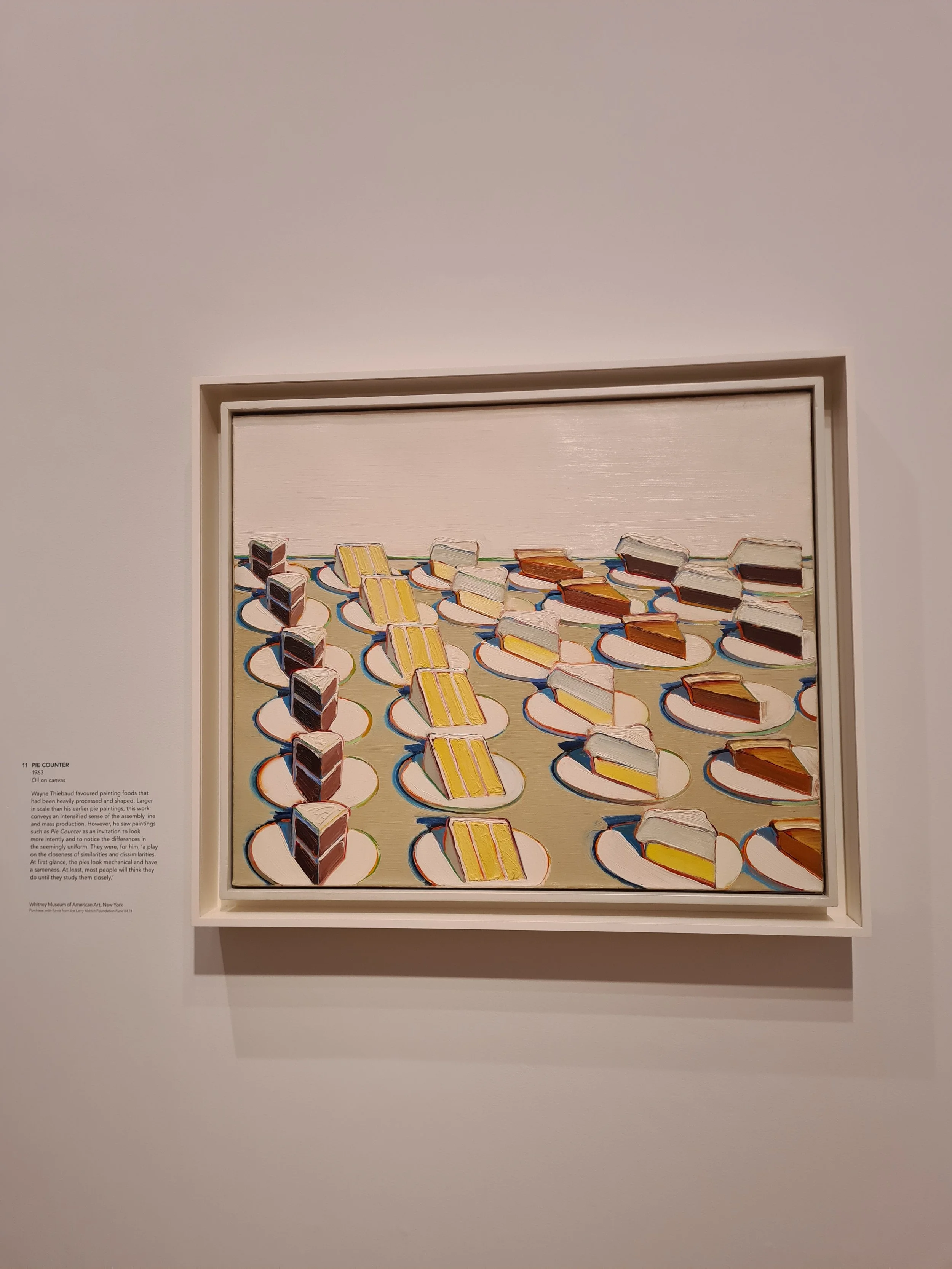
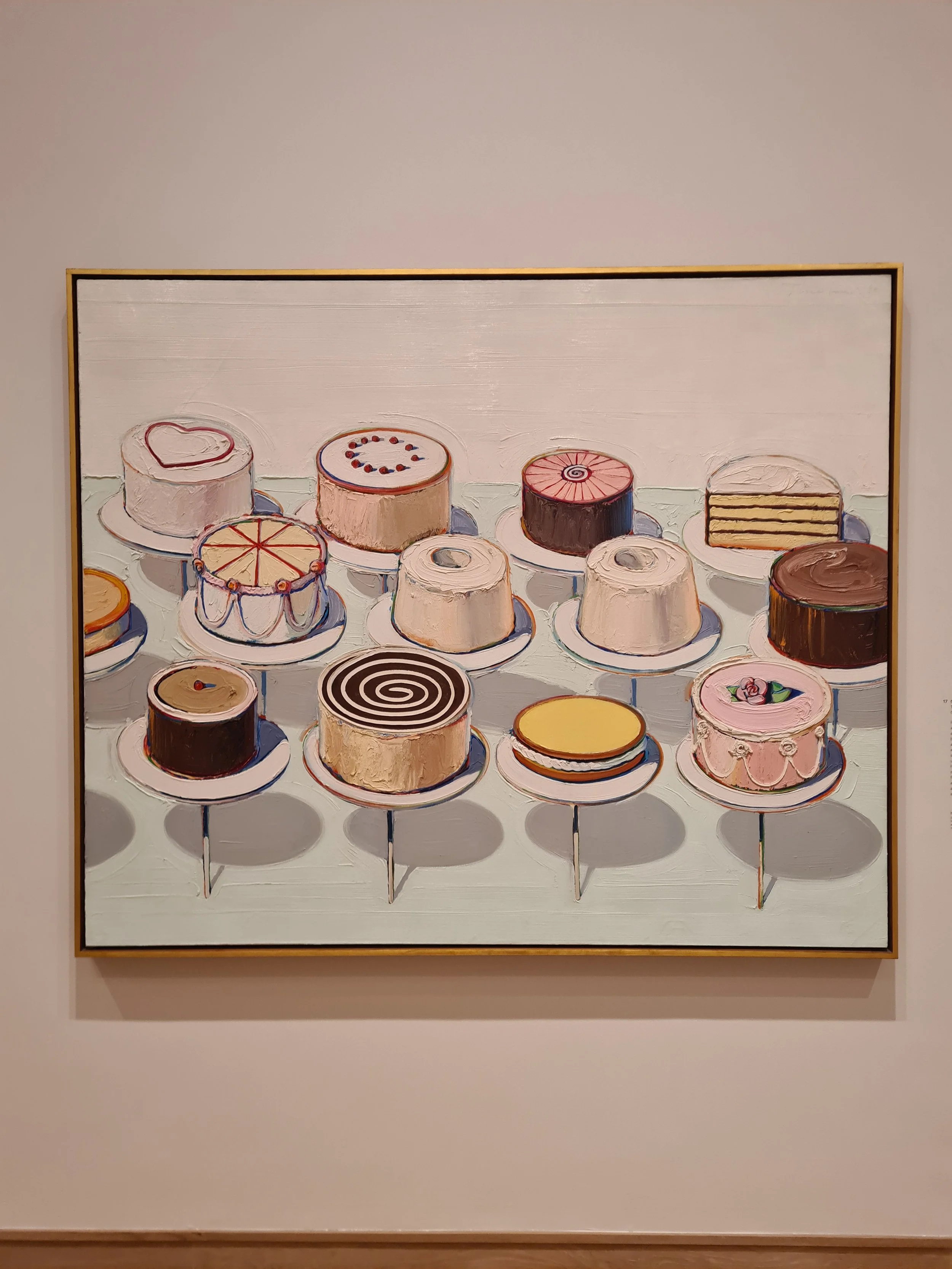
[00:21:58] Upstairs at the Courtauld. I sit for a while on the benches in the middle of the gallery. And just enjoy being around the paintings. Some of them are incredibly familiar to me. I've seen the gumball machines and the cakes many times, and I'm surprisingly moved to see the originals in real life. The thick streaks of paint bearing the unmistakable trace of the artist's brush.
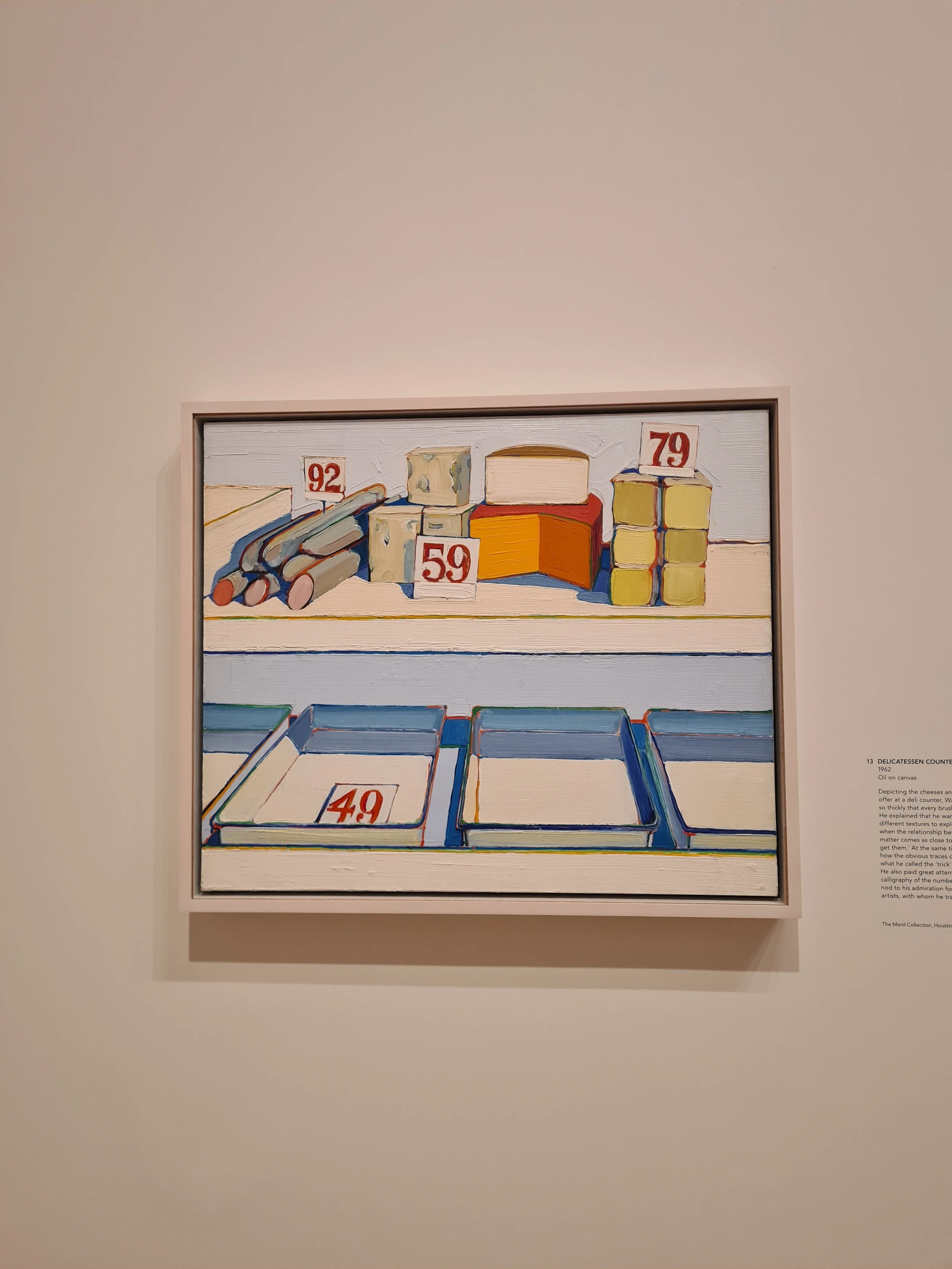
[00:22:24] Most though I haven't seen before, even in reproduction, and I love them. Particularly two charming depictions of deli counters, one selling meat, and the other cheese. Wayne Thiebaud was credited with recasting the traditions of still life painting in the mid 20th century. Dubbed the Laureate of lunch counters and diners, he used the geometry of cake slices and blocks of cheese to explore the technicality and precision potential of painting. Like many still life artists before him.
[00:22:57] But unlike your Kalfs, your Cezannes, Thiebaud's work was relatable. It not only reflected the taste of postwar America, but celebrated them. The cakes are beautiful and you could afford to buy them from the diner. Before he fell in with a circle of conceptual artists and started painting full time. Thiebaud worked as an animator and also as a commercial artist illustrating for advertisements.
[00:23:26] Looking back on his art from an environment and a society so rampantly, consumerist that I barely go a few minutes at a time without seeing something being sold to me, whether on the street, the side of a bus, or on one of my screens. It becomes difficult to draw a line between depiction and being sold. The works by Wayne Thiebaud in this gallery could be an advert. They're uncomplicated in style, direct, mouthwatering.
[00:23:59] I am wondering which paintings the shop sells as prints, I write in my notebook. What would I be conveying with this on my wall? What am I trying to say when I post the photos I took at the exhibition on Instagram later? I like art? My tastes are good and relatable? I understand the beauty of everyday life?
[00:24:20] The next day, I take a photo of the cake counter at my local bakery and post that on my Instagram story too.
[00:24:28] Interestingly, I read an interview conducted with Thiebaud while he was still alive, which reveals that it's actually only his portraits, which aren't part of this court old exhibition, which is entitled American Still Life, that he paints from life. The rest, the salami, the slabs of cheese, the wedges of pie, the ornate rounds of lacquered cake iced with his signature mastic thickened oil paint are painted from memory. Does that still count as still life? If the arrangement is only assembled in the artist's mind's eye?
[00:25:06] Ben: I think there's like definitely a romantic feeling, of having a physical thing in front of you that you're painting from.
[00:25:13] Lucy: Mm-hmm.
[00:25:14] Ben: So the way I've done it, you can kind of see on the painting in front of me. So it's a, a painting that I'm currently working on.
[00:25:19] There's one to the left of it, which is, Britney Spears's, hit perfume Fantasy, I think it's called. And then another one that I'm working on of Palestine Cola.
[00:25:27] So I am a huge Diet Coke fan, and have been slowly weaning myself off because of everything that is going on, with the genocide that's going on in Palestine, and I sort of started working on this out of like hopelessness, really. It's just like so devastated. And I was thinking about like, I mean, it literally says Palestine in big red letters on the side of it.
[00:25:50] And I think the purpose of still life, a lot of people do use it to, like I am, to build on the skills that they already have. But I think for that reason, because it is like a, a style or what's the right word? Like a genre of painting.
[00:26:08] It can be quite like. It's purposeful and therefore there's not like Yeah, it's intentional. Yeah. There's, there, there can be an element of like, I just need to put something in front of me to paint and not thinking about like, and not everyone has to be. Make art that is trying to convey more than an aesthetic reason.
[00:26:30] And there's so many beautiful paintings that I love that are just aesthetic. But I think what, yeah, what I'm interested in and what I've like found that I'm more drawn to when I am painting is, yeah, what is the image saying and how do I interpret it? Why am I painting it? And what can I do to sort of like, play with the history of painting really?
[00:26:55] When you first spoke to me about this, I started doing a bit of research and thinking about the still life historically.
[00:27:00] One of the main, things that came up was that these were often paintings that were like commissioned by wealthy people. What they were trying to communicate was either their wealth, status, taste level.
[00:27:13] So there would be things like exotic fruits, that was a big one, or like, meat was a big one, livestock. And I think often the people who were painting them were from a more well off background. I mean, not always, but in a lot of cases.
[00:27:26] And I think this brings onto an artist that we were talking, Noah Verrier who... his paintings, I think they're amazing.
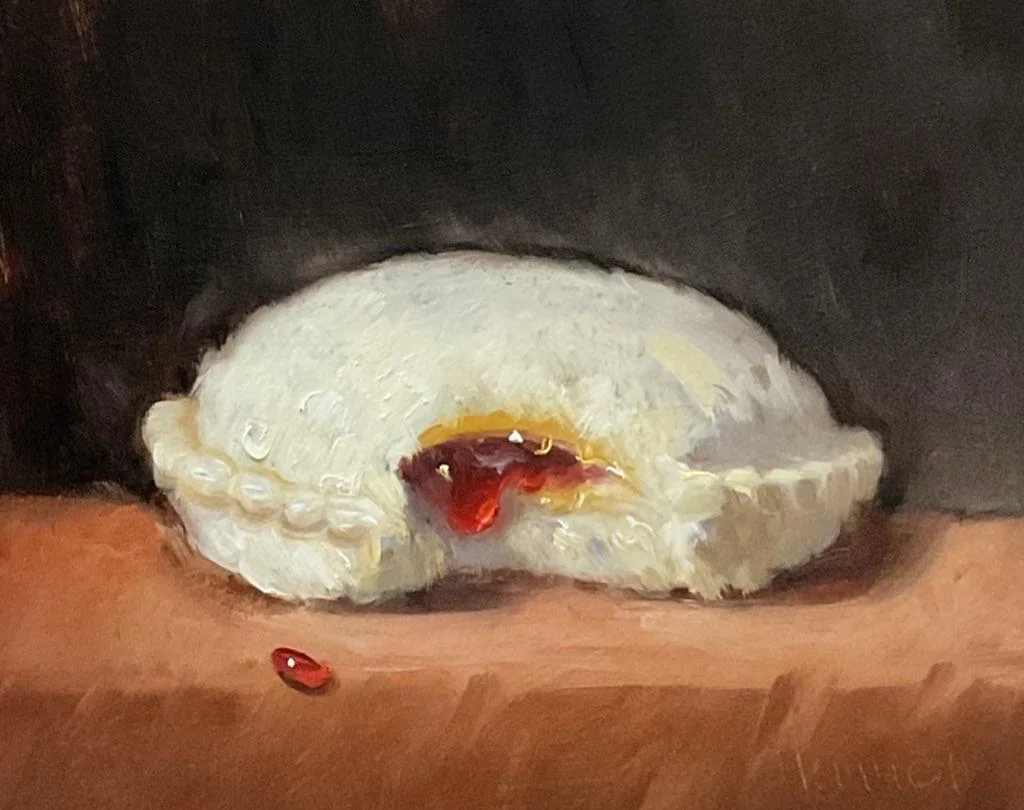
[00:27:32] They're very classical, still life, but they're of sort of like everyday things. Peanut butter sandwiches, McDonald's burgers. He did one like of a monster can the other day. And it clearly resonates with people 'cause he's massively popular.
[00:27:46] Lucy: Noah Verrier is a Florida based artist who funnily enough cites Wayne Thiebaud as an influence and the New York Times in a feature about Verrier selling a painting of an Uncrustable sandwich for just shy of $5,000 noted that processed food had been a preoccupation of Thiebaud long before Verrier started painting full-time in 2017.
[00:28:10] In contrast, however, Verrier does. Absolutely paint from life. The NYT article includes a photo of him holding the sandwich, painting in front of his sandwich model, extruding blob of jam and all. It took him two days to paint it apparently. So he did throw the sandwich out afterwards, but he buys a lot anyway as his four kids are all big fans, and for me, there's definitely something... almost reassuring about the fact that he's painting foods that his family eats rather than something that feels like a more abstract comment on social eating habits.
[00:28:51] Ben: What is it about his work that resonates with people? And I think it's because these are sort of like everyday things. Even you get though, you think in, in terms of like fruit and things like that. At the time, that wasn't something that... like an orange wasn't something that everyone had access to and it was seen as sort of like a luxury or exotic in air quotation marks.
[00:29:14] Although there are times when like artists did use their lives to communicate something. So like skulls were a big thing. There may be a big pile of fruit and like one of the fruits will be rotten. There's that where like artists are using symbolism in their work.
[00:29:26] Lucy: This symbolism is widely recognized by art historians when they're looking at still life. In her cookbook. The Dutch Table: Gastronomy and the Golden Age of the Netherlands, Gillian Riley considers whether the paintings of this era actually tell us anything about how people ate, and broadly concludes that they were different worlds.
[00:29:48] Prioritizing symbolism, whether religious or metaphorical explains why images of market stalls disregard seasonality and realism to show young peas, which would grow in late spring side by side with blended medlars and parsnips, which would be winter.
[00:30:08] Conversely, Noah Verrier's paintings are realistic in the truest sense of the word. He depicts the objects beautifully, but also faithfully. We know the sandwich was in his studio.
[00:30:24] Ben: I think about my family who aren't really like into art. If you put something that's like one of Noah's paintings, let's say a peanut butter sandwich in front of them, that is in terms of skill and mastery of painting, is it the same level as a historical painting of a Mir or whatever? Exactly. I think what they would find much more interesting and be much more drawn to is the thing that they can relate to. Mm-hmm.
[00:30:51] And I think so much of still life work in history is linked to class. Mm-hmm. And the. Majority of paintings that we've all seen, whether that's a overflowing bowl of different fruits or like a big banquet. It's so tied to those upper classes and it's really interesting to me that only it feels like, anyway, maybe I'm wrong, but it feels like only now, that I've seen artists really focus in, or, I dunno if this is like a current trend at the moment of, artists focusing these traditionally excellent paintings on sort of like everyday things. Mm-hmm. Like a kind of monster yeah. Rather than something that would, I'm trying to think like Yeah. The things that we were just, I guess
[00:31:40] Lucy: like a champagne glass
[00:31:41] Ben: Exactly.
[00:31:42] Lucy: Or, or a cocktail. Yeah. Or something that feels like. Quote unquote luxurious.
[00:31:47] Ben: Yeah.
[00:31:47] Lucy: I think that one of the reasons that Noah Verrier's work feels so novel to us, and maybe one of the reasons why he's gained this huge popularity, particularly in online spaces, is that we are more likely to encounter images of the snack and fast foods that he paints in advertising or conversely accompanying cautionary news articles about obesity or our salt intake or UPFs, but Verrier instead gives them room as cultural objects.
[00:32:32] He gives them the gravity that historically was given to seafood platters or citrus fruit or market stalls filled with produce. Like many male still life artists from history, there are no domestic scenes, but this actually feels fitting in this case as so many of these foods are in themselves quite removed from domesticity, designed often as they are to eat on the hoof, like the triangular packaging from a meal deal sandwich.
[00:33:09] The other thing that these paintings and Noah Verrier as an artist himself, highlight for me is the shift towards social media as gallery or art collection. It's no longer just the elite who collects art, with the only opportunity for displaying these precious pieces, being on the wall of a grand home, anyone can share a piece of art, post it to their story, you know, make a video about it, post it on whatever social media platform, and it's publicly visible alongside you and it immediately communicates something to anybody watching about your tastes, your politics, how you wish to be perceived.
[00:33:57] Ben: I think what is so lovely is that like. My mom will see like a Facebook reel and she'll send that like, of like a painting that she thinks I might like and she'll send it to me and we will have like a conversation about it, like maybe when I next speak to her.
[00:34:14] Um, I think that's really nice and like my mom, like isn't someone who goes to galleries often. Um, and how nice is it that people who can't or don't go to galleries off of that often for whatever reason?
[00:34:26] I meant a discord, that Gabrielle from the white Pube set up and I wrote in there when we first started speaking about doing this episode. Like what are people's favorites still lives?
[00:34:36] Lucy: Mm.
[00:34:37] Ben: Um, and it's really interesting, like the how. The things that people find differently. And there was like a few artists, like there's this one called, um, Georgio, and he does these really like
[00:34:52] Lucy: Oh yeah.
[00:34:52] Ben: Kind of monochrome images. Um, 'cause I think like when I think of a still life, I think of that like very traditional, like
[00:35:01] Lucy: photo realistic.
[00:35:02] Ben: Yeah. That's like reminiscent of like the masters or whatever. But there's like. Like Giacometti, um, as well, like these really like intense, um,
[00:35:16] Lucy: images. Looks quite
[00:35:16] Ben: images chalky. Yeah. Yeah, yeah. Um, and it's such like, uh, there's so much like, I mean, to me it looks like very, like, aggressive, this drawing that we're looking at.
[00:35:26] Um, and then there's these like placed fruit on there. So I think there's like exciting things that people have done with, uh, and are doing. Artists that are around now, um, of like, I think what a lot of people, and maybe myself at one point would've considered like a very boring genre of art. Like, for so long.
[00:35:49] I like, when I first went to uni, I was like, I wanna be an installation artist. And like everything I do is like conceptual and abstract and, um, I really like, didn't like, um, I would never like go to like. Uh, painting exhibition. Mm-hmm. 'cause I just thought painting was boring, which is really interesting.
[00:36:11] 'cause I think it's like what excites me most about art now.
[00:36:15] Lecker is written and produced by me, Lucy Dearlove.
[00:36:19] You can find Ben McDonald on instagram - I’ll post a link to his profile and also to his shop where you can buy prints of his work in the show notes,
[00:36:31] Thanks also to Katie Goh - you can listen to a longform interview with her on this podcast, released last year, and her memoir Foreign Fruit is out now.
[00:36:42] Find Lecker on instagram @ leckerpodcast - I’ll try and post every still life painting mentioned here!
[00:36:48] Music in this episode is by Blue Dot Sessions.
[00:36:52] This is an independent show which is generously supported by listeners: if you enjoy what you hear and you’re in a position to do so, you can sign up as a paid subscriber to support Lecker on Substack Patreon and Apple Podcasts! Links in the show notes. And to any paid subscribers who are listening here - thanks so much for your continued support!
[00:37:17] Thanks for listening. I’ll be back very soon.